Solar Energy Solutions Provider
solar flat roof ballasted mounting system

How Much Ballast to Hold Solar Panels Down?

When installing solar panels on flat roofs or certain ground-mounted systems, one common method to avoid drilling or penetrating the surface is the use of ballast. Ballast refers to weights, often concrete blocks, that hold the solar mounting structure firmly in place. It provides stability while ensuring the system withstands environmental forces like wind and rain. But how much ballast is actually required to hold solar panels down safely?
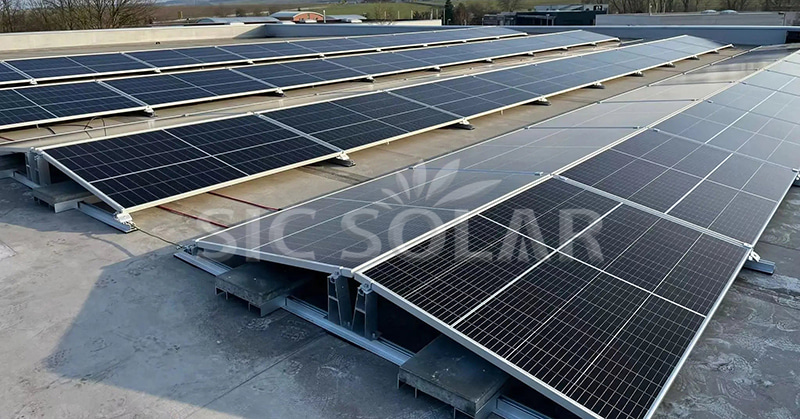
flat roof  ballasted solar mounting system

The amount of ballast needed depends on several key factors. The most important is wind load. Buildings in regions with higher wind speeds require heavier ballast to ensure that panels do not shift or lift during storms. Engineers typically calculate ballast requirements based on local building codes and wind zone ratings to meet safety standards.

Another factor is the roof structure and material. For flat roofs, especially those with limited load-bearing capacity, the weight of the ballast must be carefully balanced. Too much weight can compromise the roof’s structural integrity, while too little ballast can leave the system vulnerable. This is why proper engineering and load assessments are essential before installation.

The tilt angle and layout of the solar panels also influence ballast needs. Panels that are tilted at steeper angles catch more wind, which increases uplift forces. In such cases, additional ballast is required to counteract the pressure. Conversely, low-tilt or flush-mounted systems typically require less ballast because they present less resistance to wind.

Roof surface friction plays a role as well. A rough surface may help stabilize mounting structures with less ballast, while smoother surfaces might require more weight to prevent sliding. Snow loads in colder regions must also be considered, as they add extra force to the system.

To calculate the exact ballast requirements, professional design software and structural analysis are often used. These tools take into account building height, roof type, panel orientation, and environmental conditions. The goal is always to ensure system safety without overloading the roof.

Companies like SIC Solar, a manufacturer of photovoltaic mounting brackets, provide specialized ballasted mounting systems that distribute weight evenly and minimize roof stress. Their designs reduce the overall ballast needed while maintaining stability and compliance with engineering standards. This ensures that panels remain secure while keeping installation efficient.

Ballasted systems are an excellent solution for flat roof solar projects, but they require careful planning. The right amount of ballast will vary from project to project, making it critical to rely on expert design and high-quality mounting structures to achieve long-lasting, safe performance.
阅读全文......

How Much Ballast Do I Need for Solar Panels?

For many flat roof solar installations, ballast is a key component that ensures panels remain stable without penetrating the roof surface. Instead of drilling holes into the structure, installers use weighted systems—commonly made of concrete blocks—to keep the mounting frames securely in place. This method is especially popular for commercial and industrial buildings, where maintaining the integrity of the roof is crucial. But the question arises: how much ballast is actually needed for solar panels?

flat roof solar mounting system

The amount of ballast required depends on several important factors. The first is wind load. Solar panels on flat roofs are exposed to uplift forces caused by strong winds. To counteract this, the ballast weight must be sufficient to keep the system anchored. Areas with higher wind speeds, such as coastal regions, will naturally require more ballast compared to calmer environments.

Another consideration is roof type and capacity. While ballast is an effective non-penetrating solution, it adds significant weight to the roof. Structural assessments are necessary to ensure the building can handle the additional load. In some cases, hybrid systems that use both ballast and mechanical attachments may be recommended to reduce overall weight while still providing stability.

The tilt angle of the panels also plays a role. Systems with higher tilt angles catch more wind, increasing uplift forces and therefore requiring more ballast. Conversely, low-tilt systems present less resistance and may need less weight to remain secure.

On average, ballasted systems use anywhere from 15 to 35 kilograms of ballast per square meter, though this can vary significantly depending on site conditions. Engineers use specialized software and guidelines to calculate exact requirements based on roof layout, local building codes, and environmental factors. This ensures a balance between structural safety and system efficiency.

High-quality ballast-compatible mounting systems are critical to the success of such installations. They are designed to hold panels firmly in place while evenly distributing weight to prevent roof damage. Companies like SIC Solar, a manufacturer of photovoltaic mounting brackets, provide solutions for flat-roof ballasted systems that combine durability, ease of installation, and adaptability to different conditions. Their designs help optimize weight distribution while maintaining strong resistance against weather-related forces.

Ultimately, the precise ballast requirement for a solar project cannot be generalized without considering location, roof strength, and system design. By conducting proper assessments and choosing robust racking systems, installers can ensure that solar panels remain stable, roofs stay protected, and clean energy continues to be generated efficiently for decades.

阅读全文......